

Why Mutual Funds are better than PMS and AIF
When it comes to wealth creation, both mutual funds and Portfolio Management Services (PMS) are popular options. However, one major factor that sets them apart — and often tips the scale in favor of mutual funds — is taxation. Understanding how taxes impact your investments can help you make smarter, more efficient decisions for long-term growth. Here’s why mutual fund taxation is more favorable than PMS taxation, especially in the context of frequent buying, selling, and profits (or even losses).
In PMS (Portfolio Management Services) and AIF (Alternative Investment Funds), investors are liable to pay tax on every buy and sell transaction made by the fund manager—even if the profits are only on paper and not withdrawn. This leads to tax outgo even without actual cash in hand. However, mutual funds offer tax efficiency; investors pay tax only when they redeem their units. Until redemption, there is no tax liability, allowing money to grow uninterrupted through compounding. This makes mutual funds more tax-friendly and efficient for long-term investors compared to PMS and AIF structures.
💰 Charges on Buy/Sell Transactions: PMS vs AIF vs Mutual Funds
| Investment Type | Who Manages? | Charges on Every Buy/Sell | Who pays these charges? |
|---|---|---|---|
| PMS (Portfolio Management Services) | Fund Manager | ✅ Yes | Investor |
| AIF (Alternative Investment Fund) | Fund Manager | ✅ Yes | Investor |
| Mutual Funds | AMC/Fund House | ❌ No | No transaction charges to investor |
📌 Note:
-
In Mutual Funds, the fund manager buys/sells within the scheme, but no charges are debited directly to the investor per transaction.
🧠 Investor Tip:
If you’re looking for a low-cost, tax-efficient investment option — Mutual Funds are generally more cost-effective than PMS or AIF.
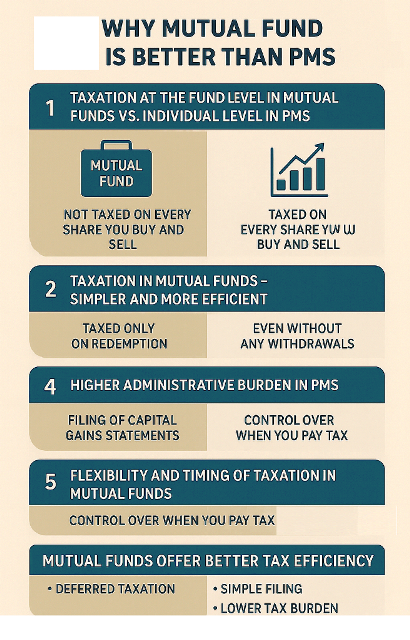
Taxation at the Fund Level in Mutual Funds vs. Individual Level in PMS
In mutual funds, all buying and selling of shares happen within the fund, and you are not taxed each time the fund manager makes a trade. Instead, you are taxed only when you redeem (sell) your mutual fund units. This makes tax planning easier and helps you benefit from compounding for a longer period.
In contrast, under PMS, every buy and sell transaction done by the PMS manager is considered your own transaction. This means:
-
You are liable to pay tax on every sale, even if you do not withdraw money.
-
You may have to pay tax even if your overall portfolio is in loss but some shares were sold at a profit.
Taxation in Mutual Funds – Simpler and More Efficient
Here’s how mutual funds are taxed in India:
-
Equity Mutual Funds:
-
Short-Term Capital Gains (STCG): 20% plus cess if held less than 1 year.
-
Long-Term Capital Gains (LTCG): 12.5%(only if gains exceed ₹1 lakh/year).
- LTCG up to Rs 1.25 lakh in a financial year is exempted from tax. On redemption, no tax is payable if the LTCG does not exceed Rs 1.25 lakh.
-
-
Debt Mutual Funds (post-April 2023):
-
Gains are added to your income and taxed as per slab, but again, only on redemption.
-
The key benefit? You are not taxed annually unless you actually redeem. That gives your money more time to grow, tax-free.
PMS – Tax Burden Every Year
With PMS:
-
Every share sold, even internally by the PMS manager, creates a taxable event for you.
-
Taxes are payable at the end of each financial year.
-
Even without any withdrawals, you’ll have to file capital gains details for all trades.
-
Losses can’t be avoided — you’ll still pay tax on some gains even if the overall performance is poor.
This creates unnecessary complexity, and more tax leakage, especially for investors who prefer passive wealth creation.
Higher Administrative Burden in PMS
Mutual fund investors receive a single statement showing purchases, NAVs, and capital gains at the time of redemption. For PMS, the investor receives a complex report of every trade, requiring:
-
A chartered accountant to compute exact tax liabilities.
-
Filing of capital gains statements, even for short-term holdings.
-
More time and money spent on tax compliance.
This adds both mental stress and financial cost, making PMS less tax-efficient.
Flexibility and Timing of Taxation in Mutual Funds
One of the biggest advantages of mutual funds is control — you decide when to sell and realize gains, giving you flexibility in planning your tax outgo. This timing control allows you to:
-
Avoid crossing the ₹1.25/- lakh LTCG threshold unnecessarily.
-
Offset gains with other losses, if needed.
-
Plan redemptions in low-income years for tax efficiency.
In PMS, you lose control because the fund manager decides when to trade, and you bear the tax consequences regardless of timing.

Mutual Funds Offer Better Tax Efficiency
While PMS may promise personalized strategies and active management, the tax disadvantage is hard to ignore. Paying taxes on every trade, regardless of redemption or overall gains, hurts long-term compounding. Mutual funds, on the other hand, offer:
-
Deferred taxation
-
Simple filing
-
Lower tax outgo (especially in equity mutual funds)
-
Better control over timing and gains
For most investors seeking long-term growth, simplicity, and lower tax burden, mutual funds clearly win over PMS when it comes to taxation. It’s a smarter, stress-free route to building wealth.
