

Risk-Free Returns Are Only 1–3% Post-inflation and Tax — Do You Know This?
When planning your financial future, one of the most important — yet most misunderstood — concepts is real returns. Many people focus on “guaranteed returns” or “safe returns,” believing these options provide security and growth. But are they really helping you build wealth after accounting for tax and inflation?
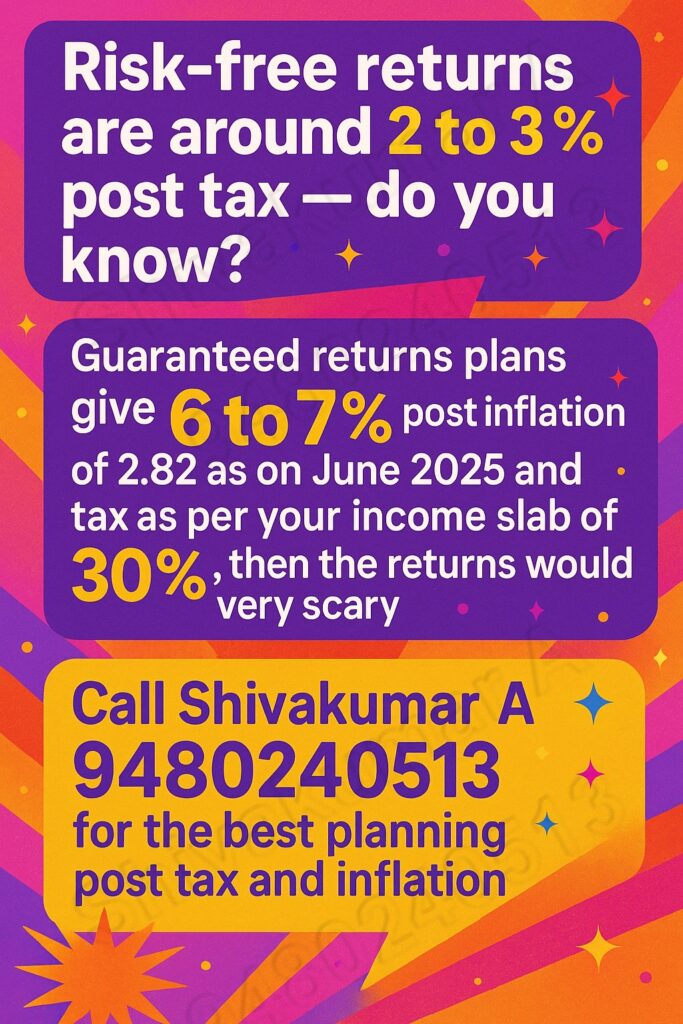
Investors still try to play safe and invest in risk-free returns without knowing the fact that the returns would be 1to 3% only after
Let’s break it down.
What Are Risk-Free Returns?
In India, the term “risk-free return” typically refers to returns from government-backed instruments like:
-
Fixed Deposits (FDs)
-
Public Provident Fund (PPF)
-
Post Office Savings Schemes
-
RBI Bonds
These are considered safe because they are not subject to market fluctuations. However, the interest income is usually taxable (except for PPF), and the returns often fail to beat inflation.
Currently, the average risk-free return post-tax falls in the range of 2–3%. Yes, that’s after you pay income tax on interest earned.
Example:
Suppose you invest ₹10 lakhs in an FD giving 6% annual interest:
-
Interest Earned = ₹60,000
-
Tax (30% slab) = ₹18,000
-
Net Interest = ₹42,000
-
Real Return = 4.2%
Now adjust for current inflation at 2.82% (June 2025): -
Real Return = 4.2% – 2.82% = 1.38%
Yes, your ₹10 lakhs grew by just 1.38% in real terms. Over time, that’s not enough to secure your future.
What About “Guaranteed Return” Plans?
Some insurance companies offer guaranteed return plans or endowment policies that promise 6–7% annual returns. At first glance, these seem better than FDs. But again, tax and inflation eat into your gains.
Let’s assume:
-
A guaranteed plan offers 6.5% annual return
-
You fall under the 30% tax slab
-
Inflation = 2.82%
Your post-tax return:
6.5% – (30% of 6.5%) = 6.5% – 1.95% = 4.55%
Now adjust for inflation:
4.55% – 2.82% = 1.73% real return
That’s only marginally better than a fixed deposit. And this is without considering the long lock-in periods or low liquidity of such plans.
The Real Problem: Scary Returns Post Tax & Inflation
Now you understand why even so-called “safe investments” may not actually grow your wealth. Over long periods, if your investments earn less than or close to inflation, you are actually losing purchasing power.
This is especially scary for:
-
Retirees relying on interest income
-
Salaried individuals saving in traditional instruments
-
Conservative investors avoiding equity markets
What Should You Do?
While guaranteed plans offer peace of mind, they cannot form the backbone of your long-term wealth strategy. You need to diversify and optimize your investments based on:
-
Your income slab
-
Financial goals (retirement, education, marriage)
-
Risk tolerance
-
Inflation outlook
Smart investors seek post-tax, post-inflation real returns, not just nominal returns.
Seek Expert Guidance
With so many financial instruments, schemes, tax implications, and market uncertainties, you shouldn’t walk this path alone.
📞 Call Shivakumar A at 9480240513
for personalized guidance on:
-
Tax-efficient investing
-
Inflation-beating strategies
-
Building real wealth
-
Choosing the right term plans and mutual funds
Returns that look good on paper might shrink significantly after tax and inflation. Don’t fall for the illusion of “guaranteed” or “risk-free” unless you fully understand the real return.
Protect your financial future with a well-thought-out plan.
👉 Let Shivakumar A help you build a smart, inflation-beating, tax-efficient portfolio.
